
AI HoloBox on-device vs cloud processing architecture: A Network and Latency Guide for Deployers
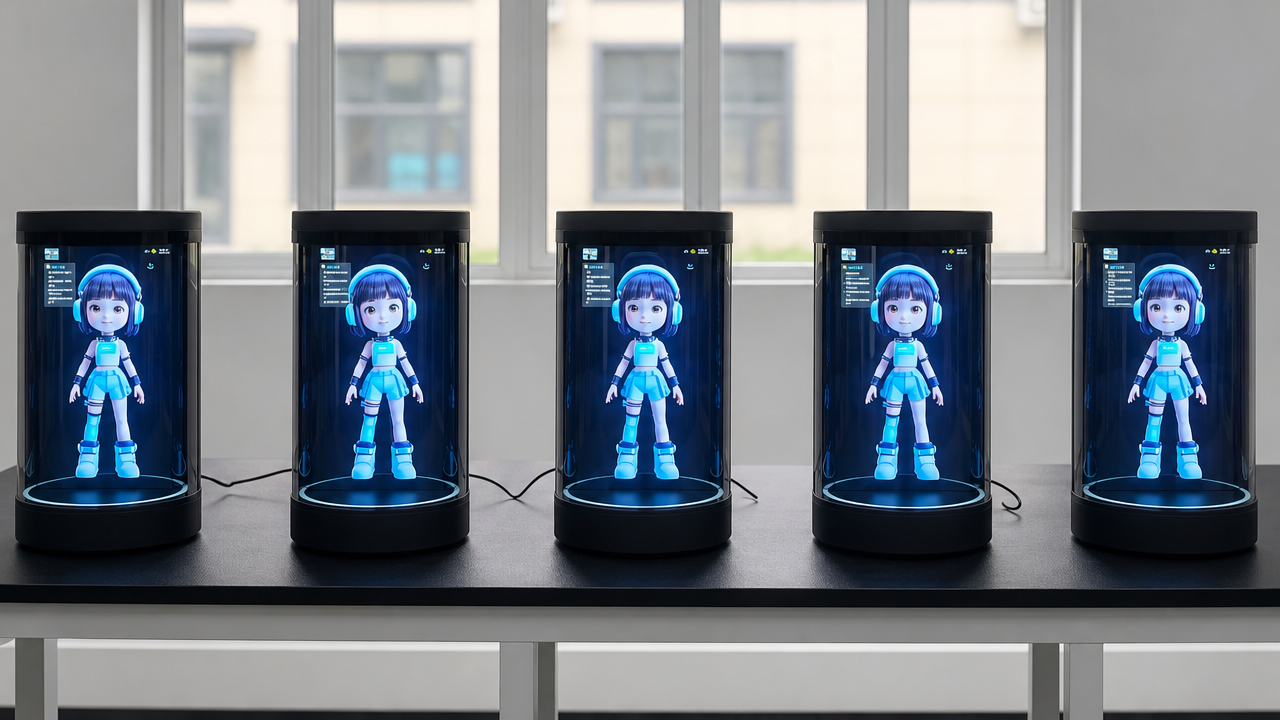
Deciding between AI HoloBox on-device vs cloud processing architecture comes down to where inference runs. On-device, the Rockchip RK3566 NPU handles wake, sensor, and avatar pipelines locally; cloud paths rely on a network round-trip and an optional LLM connector. This guide quantifies the latency and bandwidth each path demands so an integrator can spec the network — not just buy the appliance.
What an AI HoloBox Actually Does On-Device
On-device AI processing for digital signage platforms handles everything that must not wait on a network. The AI HoloBox is an intelligent digital center that combines holographic playback, virtual digital human, voice interaction, edge computing, and data storage in one compact unit ([7]). Local inference keeps those functions independent of distant cloud servers or internet connectivity, minimizing latency and running offline ([1]). Edge AI reduces latency by processing data close to its source ([2]).
Teams comparing implementation options can also consult Industrial Touch Monitor Selection Guide: Optical Bonding, Sunlight Readability & Wide-Temperature Design · Wintouch.
On-Device vs Cloud Processing Architecture: What Differs
The two architectures diverge on where inference runs. The comparison below frames edge AI vs cloud AI architectures along the dimensions that drive a network design.
| Dimension | Edge AI (on-device) | Cloud AI |
|---|---|---|
| Where inference runs | On the local NPU | Remote server/data center |
| Latency | ~1–10ms ([3]) | ~100–400ms ([3]) |
| Bandwidth demand | Negligible (local payloads) | Material (streaming + LLM) |
| Offline capability | Full | None without connectivity |
| Data residency | Data stays on-site ([4]) | Data egresses to provider |
| Cost per query | ~zero marginal cost ([6]) | Per-call or per-token billed |
| Model freshness | Static until firmware update | Continuously updated |
Latency Thresholds for Natural Conversation with a Digital Human
The digital human latency threshold for natural conversation is effectively two bands. Edge inference lands at 1–10 milliseconds; cloud AI measures 100–400 milliseconds ([3]). For a voice interaction real-time response threshold, the difference is audible and physical.
| Band | Latency | Feel in a live voice interaction |
|---|---|---|
| Edge (on-device NPU) | 1–10ms | Instant — dialogue feels continuous |
| Cloud (remote inference) | 100–400ms | Perceptible pause between turns |
Low-latency workloads measured in milliseconds are hard for centralized cloud to meet ([5]). Whether the 100–400ms band is acceptable depends on your interaction model.
How the HoloBox Processes Voice and Renders the Avatar in Real Time
Holobox real-time avatar rendering and voice processing is a staged pipeline. The RK3566 carries a quad-core Cortex-A55 CPU, a G52 GPU, and a 0.8 TOPS RK NN acceleration block ([8]). Each stage maps to a subsystem:
- Motion/voice sensor capture → sensor controller and microphone.
- On-device wake word → low-power CPU/Cortex-A55.
- Local intent handling → the 0.8 TOPS NPU handles wake, avatar, and sensor pipelines plus local Q&A.
- Local vs cloud LLM split → a ChatGPT connection is optional and cloud-only ([7]), implying network dependency.
- 4K avatar render on-device → G52 GPU drives the 6-inch holographic LCD ([8]).
Network Bandwidth Requirements for an AI HoloBox Deployment
AI HoloBox network bandwidth requirements depend on whether the conversation stays local or streams to the cloud and back. The connectivity spec is WiFi 5 802.11a/b/g/n/ac 2x2 MIMO ([8]). For WiFi 5 bandwidth in digital human streaming, the ceiling comfortably carries the small payloads of on-device inference, which consume almost nothing per interaction. The cloud path is different: streaming a live avatar plus an LLM round-trip per utterance consumes measurable throughput continuously.
| Workload | Payload per call | Sustained hourly use |
|---|---|---|
| Local inference | Negligible (bytes) | Near zero |
| Streaming avatar over WiFi 5 | Small continuous stream | Material sustained bandwidth |
| Cloud LLM + streaming | Full voice + LLM round-trips | Highest |
When bandwidth is negligible (local) versus material (cloud LLM + streaming avatar), page a site survey accordingly.
When to Choose On-Device, Cloud, or a Hybrid Architecture
Choosing between a cloud-connected vs edge AI digital human depends on site constraints, not preference. Work this checklist:
- Venue reliability — unpredictable connectivity? Prefer on-device.
- Offline needs — must the avatar answer with no internet? Edge-only provides full AI hologram offline capability; cloud paths add an external dependency.
- Enterprise CRM/POS/IoT integration — does interaction need live business data? Cloud helps.
- Data residency — must conversation stay on-site? Edge keeps it local ([4]).
- Model-update cadence — frequently refreshed answers demand a cloud or hybrid architecture with local-cloud sync.
Integrating On-Device AI with Enterprise Systems
AI HoloBox integration with enterprise systems follows a few repeatable patterns. The device runs Android 11 and exposes a Digital Human, Intelligent Voice Interaction, and IoT platform, with an optional ChatGPT connector that adds LLM call latency on top of the 100–400ms cloud band ([7]). Enterprise CRM, POS, and IoT ecosystem connectivity routes through that platform; a CMS/SoC control layer manages content ([9]). Treat any ChatGPT API integration as latency overhead added to the local pipeline.
Planning Worksheet and Net Deploying Checklist
Closing an AI HoloBox on-device vs cloud processing architecture decision means turning the above into a writable requirement. An integrator can lift this checklist straight into an RFP or site survey.
For a practical vendor example, readers can review wintouchtech.com.
- Confirm inference mode — on-device, cloud, or hybrid AI architecture local-cloud sync.
- Set a latency budget per interaction — edge (1–10ms) vs cloud (100–400ms) expectation.
- Size bandwidth headroom — WiFi 5 2x2 MIMO ceiling vs streaming + LLM load.
- Define offline run-time — how long the avatar must answer with no connectivity.
- Map sensor pipeline coverage — motion/voice capture to on-device wake and intent.
- Confirm CMS/SoC platform control for content updates.
- Document CRM/POS/IoT integration and its added latency.
- Add a failover plan — fallback to on-device Q&A when the cloud LLM is unreachable.
For the physical survey and site connectivity, see the deployment planning guide; for programming the content the avatar delivers, start with the content strategy guide.
Related guides
- AI Digital Human Display Deployment Planning: A Site-Survey Guide for Banks, Hotel Lobbies and Government Counters
- AI Digital Signage Content Strategy: A Procurement Decision Framework
Content reviewed: 2026-08-06.
Evidence confidence
Confidence: Medium. This rating reflects cross-checking 9 sources across 9 independent domains. It measures evidence coverage, not certainty; verify safety-critical work against manufacturer instructions and local requirements.
References
APA 7th edition
- ↑Objectbox. (2025). Edge Computing Archives. https://objectbox.io/tag/edge-computing/.
- ↑Tierpoint. (2025). The Future of Cloud Computing in Edge AI. https://www.tierpoint.com/blog/cloud/cloud-computing-edge-ai/.
- ↑Cited 3 timesMedium. (n.d.). Edge AI and On-Device Models: The Reality Check ... - Medium. Retrieved August 6, 2026, from https://canartuc.medium.com/edge-ai-and-on-device-models-the-reality-check-nobodys-talking-about-abf189776d01.
- ↑Cited 2 timesESLUA. (2026). Benefits, Use Cases, and Edge vs Cloud - ESL. https://eslua.com/blog/what-is-edge-computing-edge-vs-cloud/.
- ↑NIH. (n.d.). Recent Advances in Evolving Computing Paradigms - PMC. Retrieved August 6, 2026, from https://pmc.ncbi.nlm.nih.gov/articles/PMC8749780/.
- ↑Mindstudio. (2026). On-Device AI vs Cloud AI: Why the Economics Are Shifting. https://www.mindstudio.ai/blog/on-device-ai-vs-cloud-ai-economics.
- ↑Cited 3 timesRxweb Prd. (n.d.). Technical Specification AI Holobox. Retrieved August 6, 2026, from https://pub-mediabox-storage.rxweb-prd.com/exhibitor/products/exh-451d43a5-7332-457e-92fc-ee71c6172239/product-documents/pro-601828d9-9d1b-42e3-9a2b-820de76fbf1e/d9db03ef-40e0-40c2-acc5-33c1c8c5a38b.pdf.
- ↑Cited 3 timesAiholobox. (n.d.). AI HoloBox. Retrieved August 6, 2026, from https://www.aiholobox.com.
- ↑Interactive holographic displays. (n.d.). AI Avatars on Holobox. Retrieved August 6, 2026, from https://hereweholo.nl/en/ai-avatars-on-holobox-explained.
You should also read:
Edge AI vs Cloud for Android Tablet Fleets: An NPU, Memory and On-Device vs Cloud Decision Framework
Edge Ai Vs Cloud For Android Tablet Fleets is the decision framework examined in this guide. The sections below turn sourced evidence into practical comparison criteria without overstating what the available research can prove. For an Android tablet fleet, edge AI vs cloud is a…
Continue reading...
AI Holobox Microphone and Speaker Placement
Put the AI digital human kiosk’s microphone array close to the user, isolate the speaker from that array, and run acoustic echo cancellation (AEC) where it adds least latency. Your loudspeaker output reaches the microphone 30–50 dB louder than the user’s voice from across the…
Continue reading...
On-Device vs Cloud AI Compute for Self-Service Kiosks: A Latency and Deployment Decision Framework
On-Device Vs Cloud Ai Compute For Self-Service Kiosks is the decision framework examined in this guide. The sections below turn sourced evidence into practical comparison criteria without overstating what the available research can prove. The on-device vs cloud AI compute decision for self-service kiosks comes…
Continue reading...